Whale Songs
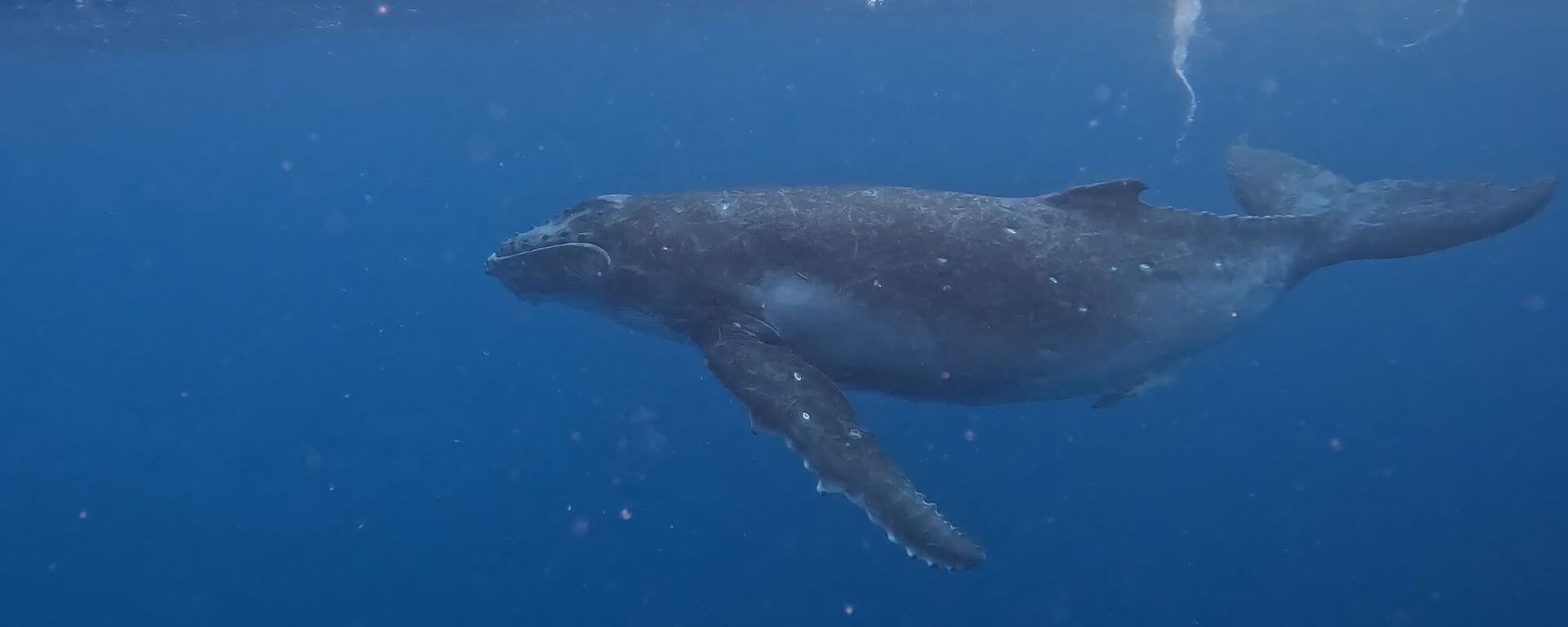

Whale breath is inspiration for sound, song and movement. Dive into the Big Blue Love of our shared oceanic home and breathe, sing and dance with them.
Whales sing in blue. Their individual vocalizations – their breath broadcasting through their tissue into the Big Blue Love that bore all life – become songs unique to their pods. Their songs travel, vibrating the ocean with music. This music permeates all who ocean dwell, singing their tissue with rhythm, sound, and breath. Whale breath is a powerful force.
These magnificent emissaries of compassion and altruism contribute to the very oxygen we breathe. Their excrement dissolution, in concert with the plant nation, provide us with our oxygenation.
Whales were once land dwellers who, like all of us, have oceanic origins. As pakicetus, semi-aquatic wolf-like mammals, or ambulocetus, the “walking whales”, a somewhat crocodile’ish ancestor in whales’ amphibious transition from earth back to water, they lived on land and swam in sea. To become whale, to innovate and evolve back to an entirely watery existence, their gills long gone, their nostrils migrated to the top of their heads and became blow holes or spiracles. Their trachea and esophagus now separated, like all cetaceans, they uniquely breathe through their blow holes. Their mouths are reserved for eating and nourishment. Blow holes are protected by a muscular flap called a nasal plug. This tight “lid” seals the airway when the whale dives to stop water from entering the lungs, and the plug only closes enough to be water-tight when the whale's muscles relax into effortlessness, creating union with their watery environment.
Whales will dive deep through the many shades of blue, blue green and brown-blue created by the presence and/or absence of light while stilling their breath, sometimes for 20 minutes (humpbacks) and upwards to 2 hours (sperm whales). Through whales’ counter-evolutionary journey, they chose to choose when to breathe, voluntarily, despite a sophisticated mammalian nervous system that like ours, once could breathe involuntarily. Whales choose when to breathe, and when they breathe, they breathe movement, sound, song and life.
Choosing to Breathe Dive
To experience the power of choosing to breathe, select whale-infused music or recordings of whale vocalizations to accompany you (or not). Here’s one I love of humpbacks in Monterey Bay:
https://youtu.be/GzSr4S3ratw?si=4YpUFAAU8B1Yh-az
1. Settle into your moving space lying down, side-lying or whatever shape in the horizontal dimension suits your body right now, Take a baseline of your breath.
2. Send lunars (Lunar Breath) into all the layers of tissue in your body in your natural flow and rhythm. You might begin in one area and “spread” the lunars, or “hopscotch” lunars around your body, or fill several areas at once. As breath enters your tissue layers, cavities and spaces, boney structures and fluid currents and streams, be breathed and moved. “Fill” your body with lunars to invite movement in and between these areas of your body, until your whole body is moving lunars. I call this “inner whale breathing”.
3. Pause your breath periodically*.
4. Open attention when your body tells you it's time to whole body pause.
5. Outer whale breathing: Using Ocean Breath (an open-mouthed audible lunar), fill the space immediately around you with the sound. Transform your current environment into ocean, making it any watery shade(s) of ocean color you wish. Pause frequently. Pause both your breath and your “oceanizing” of the environment. Slowly, extend this “oceanification” as far out into the room/space/state/country/world you want to. Pause, rest and resume until your floating body cues you to drift into open attention.
6. Oscillate inner and outer whale breathing until you become whale, returning home to Big Blue Love.
*Pausing breath is not the same as holding it. Holding it is static. Pausing it, we don’t exhale but we don’t HOLD our breath inside. We “keep” breath flowing inside of us, moving it around to massage our inner landscape, “watering” and moisturizing our inner earth. Whales do something like this to vocalize and move, and freedivers do something very akin to this to remain underwater.
Photo by Amber Elizabeth Gray